


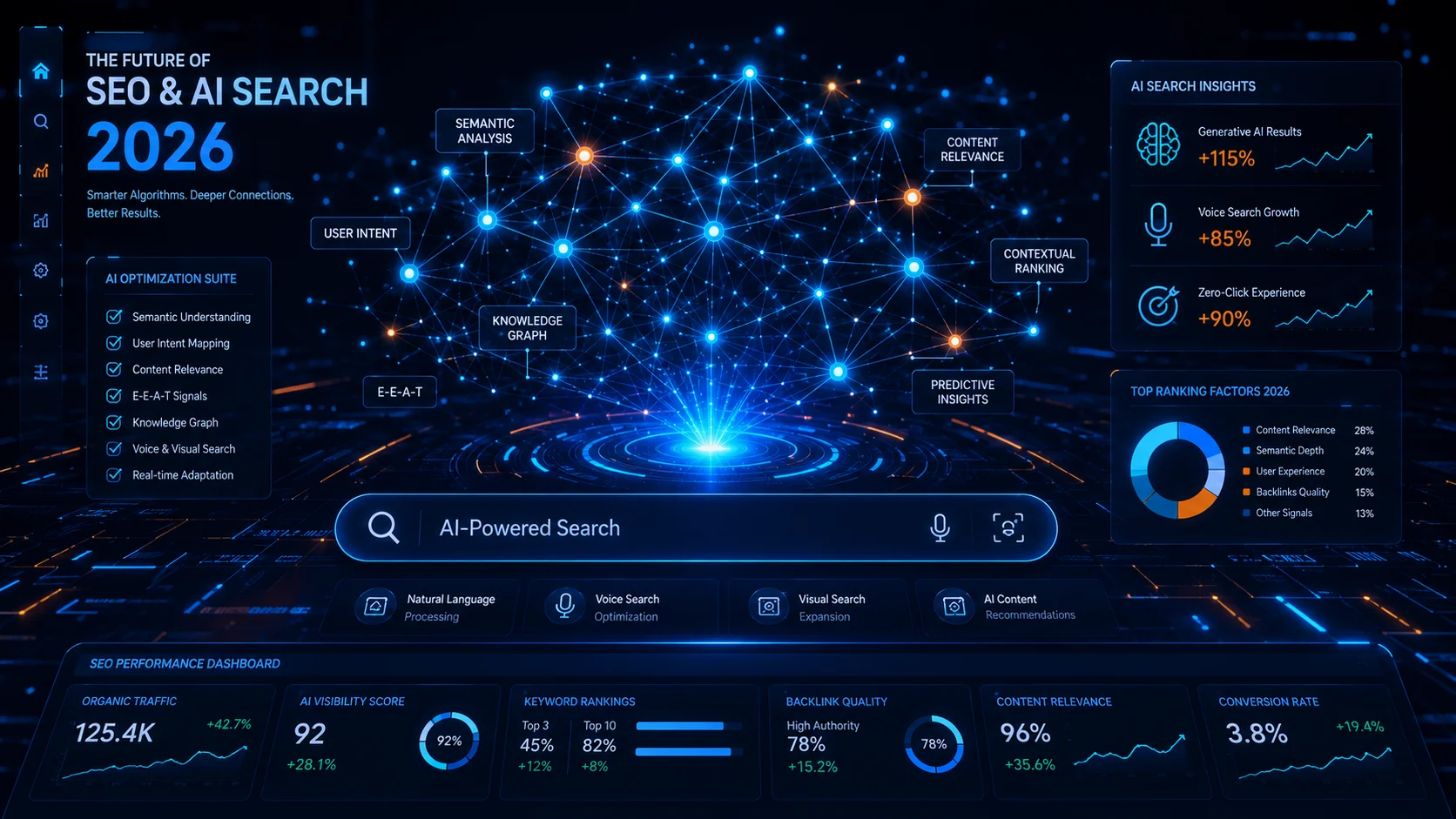
Search has changed more in the last two years than in the previous ten. Google now shows AI Overviews above many results, its AI Mode answers questions in a conversation, and millions of people search with ChatGPT and Perplexity. Many searchers get an answer without clicking anything.
That does not make SEO pointless. It changes what winning looks like: being the page that ranks, and the source that AI answers quote. This guide covers what still matters, what is new, and a practical checklist you can work through.
How search changed
Google began showing AI-generated summaries, now called AI Overviews, in 2024 and has since rolled them out widely, followed by an AI Mode for longer, conversational searches. Outside Google, ChatGPT search and Perplexity answer questions directly and cite their sources.
Several industry studies have measured lower click-through rates on searches that show an AI Overview, especially for simple informational questions. Searches with clear buying intent, such as "custom ERP developer in Dhaka" or "POS system for a pharmacy", still send plenty of visitors to websites. Those are the visitors who become customers.
Google's own guidance is that there is no special trick for appearing in AI features: the same practices that help pages rank are what make them eligible to be shown and cited.
7 things that matter most in 2026
1. A technically healthy site
Search engines and AI crawlers must be able to reach, read and understand every important page. Check that pages are indexable, that there is an XML sitemap, that redirects are clean and that the site uses HTTPS. Then check speed against Google's Core Web Vitals:
| Metric | What it measures | Good score |
|---|---|---|
| Largest Contentful Paint (LCP) | How quickly the main content appears | 2.5 seconds or less |
| Interaction to Next Paint (INP) | How quickly the page responds to taps and clicks | 200 milliseconds or less |
| Cumulative Layout Shift (CLS) | How much the layout jumps while loading | 0.1 or less |
Heavy page builders and long lists of plugins are the most common reason sites fail these checks. Fixing the cause in the code usually beats adding yet another optimisation plugin.
2. Clear answers, well structured
Put the answer first. Under each heading, start with one or two sentences that answer the question directly, then add the detail. Use descriptive headings, short paragraphs, lists for steps and tables for comparisons. This helps readers skimming on a phone, and it makes your page easy for Google and AI systems to understand and quote.
3. Real experience and trust
Google's quality guidelines put weight on experience, expertise, authoritativeness and trust, often shortened to E-E-A-T. Generic content is now cheap to produce, so what stands out is what only you can offer: your own photos, real project examples, original data, clear author information and honest opinions based on doing the work.
4. Structured data
Schema markup tells search engines exactly what a page is about: your business, a product, an article, a review. Add Organization or LocalBusiness markup to your site, and Product, Article or Service markup where it fits. Note that since 2023 Google shows FAQ rich results only for a small number of well-known authoritative sites, so FAQ markup alone will rarely change how you appear.
5. Covering a topic completely
AI answers often break a question into several smaller searches behind the scenes. Pages that cover a topic properly, including the follow-up questions people naturally ask, have more chances to be used. Group related pages together and link between them so both people and crawlers can follow the thread.
6. Brand mentions, reviews and local presence
Links from other sites still matter, but so do mentions of your brand in reviews, directories, industry articles and communities. For local businesses, a complete and active Google Business Profile with genuine reviews is one of the most valuable things you can maintain.
7. Letting the right crawlers in
If you want to appear in AI answers, those systems need to be able to read your site. Check your robots.txt and your CDN or firewall settings. Common crawlers include Googlebot, Bingbot, OpenAI's OAI-SearchBot and ChatGPT-User, and PerplexityBot. Since mid-2025, Cloudflare can block AI crawlers by default on new sites, so it is worth checking that setting is what you actually want.
What to measure now
| Area | Old focus | Focus in 2026 |
|---|---|---|
| Main goal | More organic clicks | More qualified enquiries and sales |
| Content | Keyword density and word count | Clear answers and original insight |
| Authority | Number of backlinks | Links, brand mentions and genuine reviews |
| Visibility | Rank position only | Rankings plus appearing in AI answers |
| Technical | Mobile-friendly | Fast, crawlable and passing Core Web Vitals |
Use Google Search Console for impressions, clicks and the queries you appear for, and Google Analytics 4 to connect visits to calls, forms and orders. Watch branded searches too: when more people search for your name, your wider visibility is working.
A practical SEO checklist
- Verify your site in Google Search Console and submit your sitemap.
- Fix pages that are not indexed and any crawl errors.
- Test your key pages in PageSpeed Insights and fix the slowest first.
- Give every page a unique, descriptive title and meta description.
- Rewrite your most important pages so the answer comes first.
- Add structured data for your business, products or services.
- Complete your Google Business Profile and ask happy customers for reviews.
- Check that robots.txt and your firewall let the crawlers you want reach your site.
- Set up conversion tracking so you know which pages bring in enquiries.
- Publish helpful content regularly, based on questions customers actually ask you.
Frequently asked questions
Is SEO dead because of AI search?
No. AI answers are built from web pages, and buying searches still lead to websites. What has changed is that thin, generic content earns very little. Useful, trustworthy pages do better than ever.
Do I need to optimise separately for ChatGPT or AI Overviews?
Mostly not. Clear structure, real expertise, a fast site and crawler access cover the large majority of it. Make sure AI crawlers are not blocked if you want to be cited.
How long does SEO take to show results?
Technical fixes can show results within weeks. New content and authority usually take several months to build. SEO compounds: the work keeps paying off long after it is done.
Want help getting found?
Shawon Web offers SEO and digital marketing built on solid engineering: we fix the technical problems in the code itself, improve your content and local presence, and report every month in plain English on rankings, traffic and enquiries.
Ask for a free SEO review of your website.
Comments
No comments yet. Questions and thoughts are welcome.