

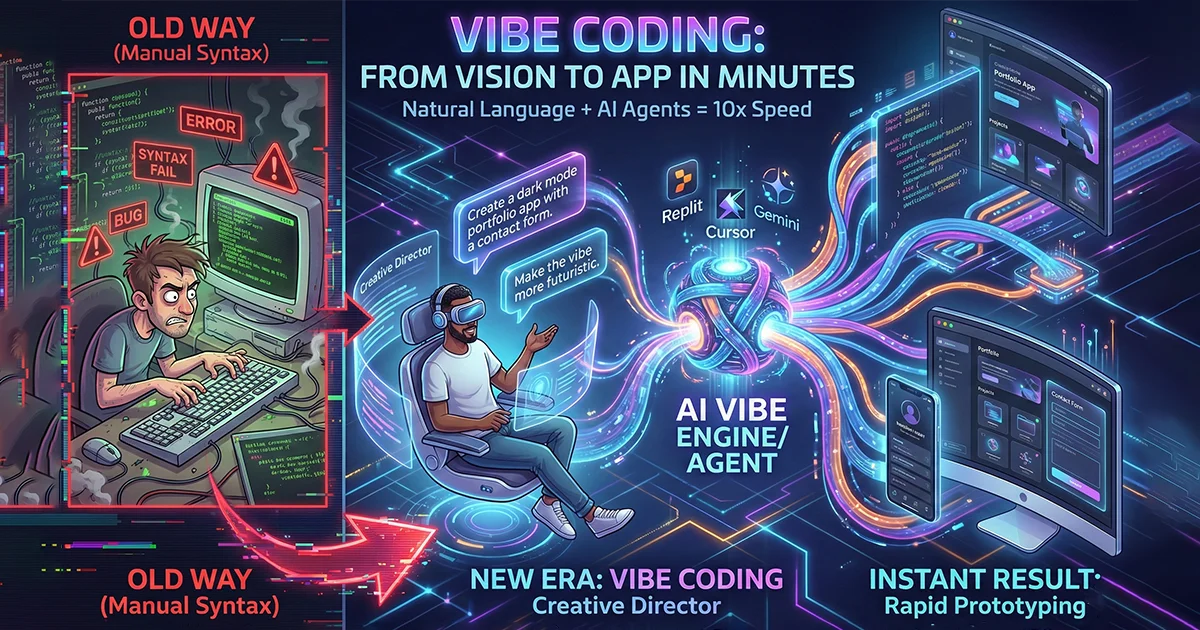
For most of the history of software, building an app meant writing every line of code yourself. In early 2025 a new phrase caught on for a very different way of working: vibe coding. You describe what you want in plain language, an AI model writes the code, and you steer by looking at the result rather than reading the code.
This guide explains what vibe coding really means, which tools people use, what it is genuinely good for, and the point at which it stops being enough for a business.
Where the term comes from
The phrase was coined by AI researcher Andrej Karpathy, a co-founder of OpenAI and former head of AI at Tesla, in a post in February 2025. He described giving in completely to the AI: accepting its suggestions, pasting error messages back to it, and barely reading the code at all. He framed it as a fun way to build throwaway weekend projects, not as a method for serious software.
The name stuck because it captured something many people were already doing. Within months, "vibe coding" was being used for everything from a quick personal tool to whole startup prototypes.
What vibe coding looks like in practice
The workflow is a loop rather than a plan:
- Describe. Write what you want in plain language, for example "a booking page with a calendar, a time picker and a confirmation email".
- Generate. The AI writes the code and usually runs it so you can see a working version.
- Check. You try it. Does it look right? Does it do the right thing?
- Iterate. You describe what to change, or paste in an error, and the AI tries again.
The human role shifts from typing code to directing: deciding what to build, judging the result and noticing what is wrong. That is a real skill, and people who are good at it get far more out of these tools.
The tools people use
Most vibe coding happens in one of two kinds of tool.
App builders that run in the browser
Replit, Lovable, Bolt and v0 let you describe an app in a chat window and see a working version within minutes, usually with hosting included. They are the easiest place for non-developers to start.
AI code editors and coding agents
Cursor, Windsurf, GitHub Copilot and command-line agents such as Claude Code work inside a real codebase. They read the surrounding files, propose changes across many of them and can run tests. This is the kind professional developers mostly use.
The models behind these tools improve every few months, so which one leads changes often. Learning a good workflow matters more than picking the "right" brand. We compare them in detail in our guide to vibe coding tools in 2026.
What vibe coding is genuinely good for
- Testing an idea cheaply. A clickable prototype is a far better way to explain an idea to a partner or investor than a document.
- Small internal tools. A calculator, a simple tracker or a one-off data clean-up used by a handful of people.
- Demos and landing pages where nothing sensitive is stored.
- Learning. Seeing working code for an idea is a fast way to understand how software fits together.
- Boilerplate for developers. Engineers use the same tools to skip repetitive setup and spend their time on the hard parts.
Where it breaks down
The thing that makes vibe coding fast, not reading the code, is exactly what makes it risky once real customers and real money are involved.
- Security. Generated code can contain missing access checks, exposed API keys or injection flaws that look perfectly fine on screen. Security researchers have repeatedly found these problems in apps built this way.
- Hidden complexity. Payments, user permissions, refunds and unusual edge cases are where most of the work in business software lives. A demo rarely exercises them.
- Maintainability. When nobody understands the code, every change becomes a gamble, and fixes start breaking other features.
- Data design. How your data is structured is hard to change later. A rushed database design becomes expensive the moment the business grows.
| Aspect | Vibe-coded prototype | Production business software |
|---|---|---|
| Main goal | Prove an idea quickly | Run the business reliably every day |
| Code review | Optional | Every change reviewed |
| Testing | Click around and see | Automated tests on the critical paths |
| Security | Best effort | Access control, validation and audits |
| Who understands the code | Mostly the AI | Your team or your developer |
| Good for | Demos, experiments, internal tools | Payments, customer data, operations |
What this means if your business needs software
AI has made professional development faster too. The difference is that an experienced engineer reads, tests and takes responsibility for every line. The savings are real, but they come from engineers using AI well, not from skipping the engineering.
A sensible approach for most businesses:
- Use a vibe-coding tool to sketch the idea and show it to the people who will use it.
- Collect their feedback while changes are still cheap.
- Have the production version built with a proper data model, security and tests, so it can grow with you.
Frequently asked questions
Is vibe coding the same as no-code?
No. No-code tools hide the code behind visual building blocks. Vibe coding produces real source code that you can export and edit, which is more flexible but means someone needs to understand it if the app grows.
Can I build a complete business app by vibe coding?
You can build something that works well in a demo. Running it safely with real customers, payments and data is a different job that needs security checks, testing and someone who can fix it when something goes wrong.
Will AI replace software developers?
It is changing the job rather than removing it. Less time goes into typing routine code and more into design, review, security and understanding what the business actually needs.
Turn your idea into software you can rely on
Shawon Web builds custom business software, web platforms and mobile apps, quoted at a fixed price and handed over with the full source code. If you already have a prototype, we can review it and tell you honestly what it would take to make it production-ready.
Request a free, fixed-price quote and we will reply within one working day.
Comments
No comments yet. Questions and thoughts are welcome.